Early Life & Family
Robert Francis Prevost was born on September 14, 1955, in the city of Chicago, Illinois. He grew up in Dolton, a quiet south-suburban community just outside the city, the son of Louis Marius Prevost — an educator of French and Italian descent — and Mildred Martínez, a librarian with Spanish roots. He was the second of three sons, with older brother Louis Martín and younger brother John Joseph.
The Prevost household was a deeply Catholic one. His mother's work surrounded him with books; his father's dedication to education instilled in him a love of learning that would carry him from Chicago all the way to Rome. His mixed heritage — a blend of Anglo-American, French, Italian, and Hispanic roots — perhaps foreshadowed the role he would one day occupy: a bridge between the Americas and the universal Church.
"I come from a family that taught me to seek God in learning, in service, and in the faces of those who are poor."
Education
Prevost attended Villanova University near Philadelphia, Pennsylvania — an institution run by the Augustinian Order — where he earned a Bachelor of Arts in Mathematics in 1977. His time at Villanova proved formative, not only academically but spiritually: it was there that he came to know the Augustinian friars and felt drawn to their charism of seeking God through community, study, and service.
Following his undergraduate years, he pursued theological formation at the Catholic Theological Union in Chicago, receiving his Master of Divinity in 1982. He then traveled to Rome, where he studied at the prestigious Pontifical University of St. Thomas Aquinas — the Angelicum — earning his Licentiate in Canon Law in 1984 and his Doctorate in Canon Law in 1987.
This rigorous scholarly formation — mathematics, theology, and canon law — gave him both a systematic mind and a deep command of the Church's legal and doctrinal tradition.
The Augustinian Vocation
Prevost entered the Order of Saint Augustine (O.S.A.) in 1977 and made his solemn, final vows in 1981. The Augustinian Order traces its roots to St. Augustine of Hippo (354–430 A.D.), one of the towering figures of Western Christianity, whose emphasis on grace, community, and the restless human heart seeking God has shaped Catholic thought for sixteen centuries.
He was ordained to the priesthood on June 19, 1982. In the years that followed, he grew into a trusted leader within his order — serving in formation, administration, and, above all, mission.
A Missionary in Peru
The defining chapter of Robert Prevost's pastoral life was not in the United States but in Peru. Beginning in 1985, he spent roughly two decades serving the people of the Peruvian Amazon and the northern coast — first in Chulucanas, then in Trujillo, and eventually throughout the Diocese of Chiclayo. He became a beloved figure in the local Church, learning Spanish and embracing Peruvian culture so fully that he later obtained Peruvian citizenship.
His ministry in Peru encompassed parish work, formation of seminarians, and administration. He lived alongside communities experiencing deep poverty, and this experience indelibly shaped his pastoral priorities: the poor, the marginalized, the overlooked.
In October 2013, he returned to the United States, serving in his Augustinian Province in Chicago as director of formation, first councilor, and provincial vicar.
Leading the Augustinian Order
Between 2001 and 2013, Prevost served two terms as Prior General of the Order of Saint Augustine — effectively the worldwide leader of the entire Augustinian family of some 2,700 friars across 50 countries. This role brought him into close contact with the universal Church, with the Vatican, and with communities of faith across every continent. He guided the Order with a quiet authority, and his reputation for prudence, learning, and genuine pastoral care spread well beyond his own religious family.
Cardinal and Vatican Leader
Pope Francis appointed Prevost Apostolic Administrator of the Diocese of Chiclayo, Peru — a sign of the pope's trust in his deep knowledge of the local Church.
Appointed Bishop of Chiclayo and formally installed as ordinary of the diocese he had long served.
Pope Francis summoned him to Rome to serve as Prefect of the Dicastery for Bishops and President of the Pontifical Commission for Latin America — among the most consequential posts in the Vatican, responsible for advising the Pope on the selection of bishops worldwide. He was elevated to the rank of Archbishop.
Created a Cardinal by Pope Francis in a consistory at St. Peter's Basilica — formally entering the College of Cardinals that would one day elect him as pope.
Pope Francis passed away. The College of Cardinals gathered in Rome for the conclave.
On the fourth ballot of the conclave — the second day of voting — Cardinal Robert Francis Prevost was elected the 267th Bishop of Rome. He chose the papal name Leo XIV.
The Name Leo XIV
The choice of the name "Leo" was rich with meaning. Pope Leo XIII (1878–1903) is remembered as the pope of workers and social justice — his landmark encyclical Rerum Novarum (1891) addressed the plight of laborers in the industrializing world and laid the foundation for modern Catholic social teaching.
In choosing to be called Leo XIV, Prevost signaled his intention to revive and extend that tradition for the 21st century: a moment defined not only by persistent poverty and inequality but by artificial intelligence, automation, and questions about the dignity of human labor in a rapidly changing world.
"As Leo XIII confronted the first Industrial Revolution with the light of the Gospel, we must now confront a new revolution — one that touches not only our labor but our very understanding of what it means to be human."
The Man Behind the White Cassock
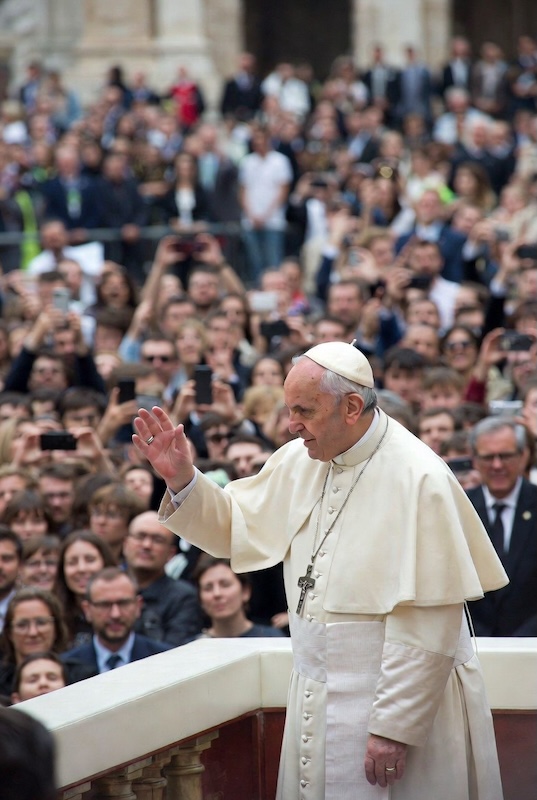
Pope Leo XIV © Vatican Media
Those who know Robert Prevost describe a man of striking intellectual depth, disarming simplicity, and genuine warmth. He is not a man of grand gestures; he is a listener, a reader, a lover of long walks and unhurried conversation. His years in Peru gave him a pastor's instincts; his years in Rome gave him an administrator's discipline; and his Augustinian formation gave him a theologian's heart.
He speaks English and Spanish fluently, and is conversant in Italian, French, and Portuguese — a linguistic range befitting a man who has served the universal Church across three continents.
As Leo XIV, he has expressed a deep commitment to synodality — the vision of a more collegial, listening Church — to care for creation, to the poor, and to dialogue with a world often estranged from organized religion. He carries into the papacy the marks of a man who has spent his life close to ordinary people, far from the center of power.